
Foundation Piling and Underpinning in Winnipeg
When a footing has lost its bearing, the fix is to carry the load somewhere that holds.
Piling is the heaviest work Winnipeg Foundation Experts does, and it is warranted less often than the internet suggests. When it is warranted, nothing else substitutes for it.
What Settlement Actually Looks Like
Settlement is the foundation moving down, unevenly, because the soil beneath a section of footing is no longer supporting it. The signs show up throughout the house rather than only in the basement.
Doors that used to close and now stick at one corner. Floors with a perceptible slope. Cracks in drywall running diagonally from the corners of door frames. Cracks in the foundation that are noticeably wider at the top than at the bottom, which indicates a section is rotating downward.
An addition or a porch pulling away from the main house is a common one here, because a shallower footing under a later addition responds to the clay differently than the original.
Why Clay Causes It
The clay under this city changes volume with moisture. It swells when saturated and shrinks as it dries, and in a dry summer it can pull away from a footing entirely, leaving a void where bearing used to be. The house then settles into that space.
Large trees close to a foundation intensify this by drawing significant moisture out of the soil through a dry season. So does a drainage problem that keeps one side of a house consistently wetter than the other. Uneven moisture produces uneven movement, and uneven movement is what cracks a structure.
How Piling Works
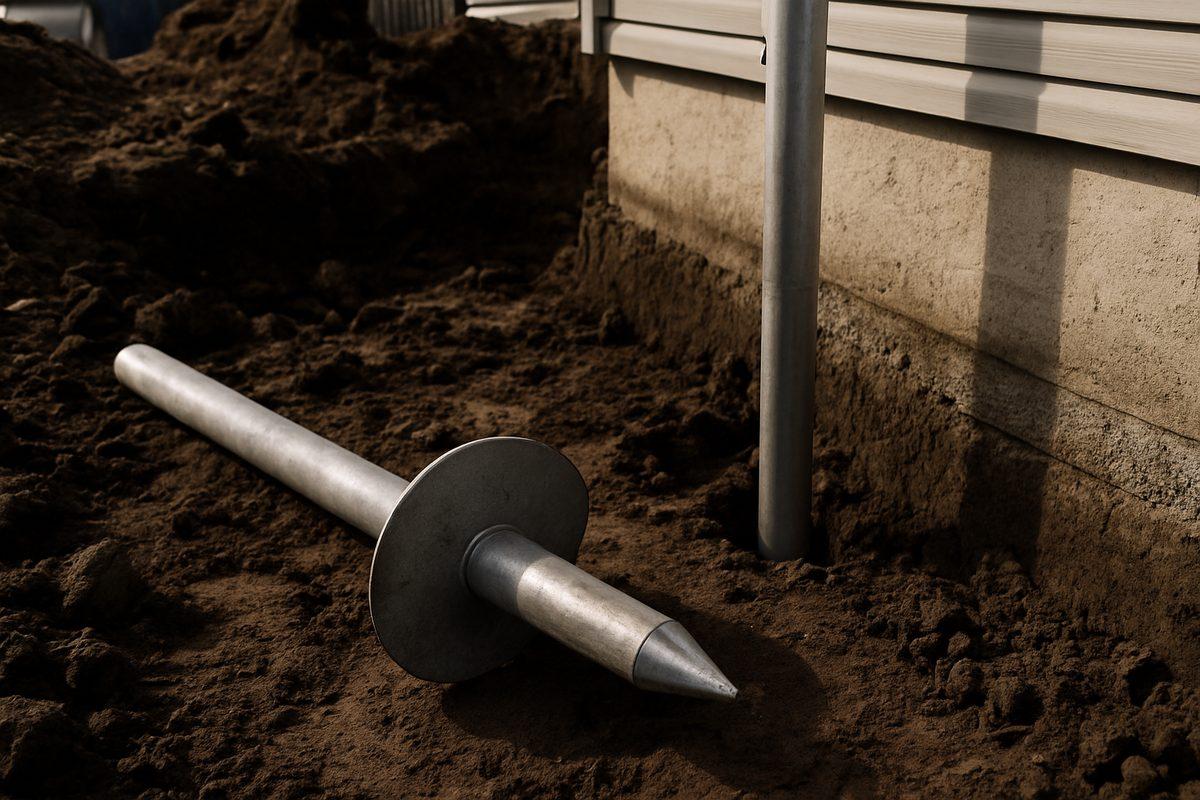
Helical piles are steel shafts with a spiral plate at the tip. They are turned into the ground beside the footing until they reach soil that carries load reliably, well below the depth where seasonal moisture changes anything. Brackets then transfer the weight of the foundation onto the piles.
The load stops depending on the clay immediately under the footing. Where the geometry suits it, the house can also be brought back toward level, though how far is a judgement made on site rather than a promise made in advance.
Deciding Whether You Need It
Not every crack means settlement, and not every settled house is still moving. A foundation that shifted twenty years ago and stabilised does not need piles. We look at crack patterns, check whether the structure is out of square, and assess whether the movement appears active.
If we do not think you need this work, we will say so. It is the most expensive thing on this site and it is the wrong recommendation for most cracked walls. Related: house leveling for the settlement symptom, bowing wall repair where the wall is being pushed rather than dropping, and foundation inspection if you want it looked at first. We cover Headingley and Selkirk alongside the city.
What's Included
- Helical and screw piles installed to load-bearing depth
- Underpinning for settled and undermined footings
- Load transfer below the seasonally active clay layer
- Assessment of whether settlement is active or historic
- Written scope before work starts
Other Services We Offer in Winnipeg
Foundation Piling & Underpinning Questions
How do I know if my house needs piles?
The signs are structural rather than cosmetic. Doors and windows that have gone out of square, floors that slope noticeably, cracks that are wider at the top than the bottom, and separation where a porch or addition meets the main house. One of those alone may mean little. Several together usually mean the footing is moving.
What is the difference between piles and underpinning?
They are two ways of solving the same problem. Piles carry the load down to stable soil through a steel shaft. Traditional underpinning extends the existing footing deeper. Which suits your house depends on access, depth to stable soil, and what the foundation is built of.
How deep do the piles go?
Deep enough to get below the layer of clay that moves with the seasons and into ground that carries load consistently. That depth varies across the city, which is why the assessment matters more than a standard number.
Will this stop the movement completely?
Piling addresses settlement, meaning the house sinking where the soil has given way. It does not change what the surrounding clay does with moisture, so drainage work often belongs alongside it. We will tell you if we think you need both.
Get a Free Foundation Piling & Underpinning Quote
Book a free assessment. We will tell you what is moving, why, and whether it needs work now.